
She Knows SEO contains affiliate links and is a member of the Amazon Services LLC Associates Program. If you make a purchase using one of these Amazon links, we may receive compensation at no extra cost to you. See our Disclosure Policy for more information.
How I Write Affiliate Blog Posts That Make Money (Without Feeling Salesy)

Affiliate posts get such a bad rap.
People think they’re scammy or salesy or just an excuse to shove random links into a post and hope for the best.
I get it! I’ve seen bloggers burn trust fast by pushing products they don’t even use, in posts that make no sense for their niche.
I’m even guilty of it! I wrote a lot of listicles on things I hadn’t done because it was “the thing to do” and I was so embarrassed I’d tell my family not to read them.
But here’s the truth: you don’t have to feel gross about affiliate income.
When you write a post that actually helps your reader make a decision they already want to make — and it fits your niche — it feels good to share. And people actually want to click.
I make over 6-figures a year from affiliate posts that do exactly that.
They’re not random. They’re not pushy.
They’re honest, useful, and connected to what I already write about. And they’re things I’d actually use and recommend even if I wasn’t being paid to do so!
I’ll show you my exact process for writing one affiliate post that makes sense, helps your readers, and earns money without killing trust.
This is the same method I teach inside the Profitable Part-Time Blogger — and you can try it for free on your next post.

Profitable Part-Time Blogger
Ready to grow a blogging business that fits your life?
The Profitable Part-Time Blogger Program helps you attract your ideal audience, master SEO, and make $5K/month—all in just 20 hours a week.
Whether it’s a side hustle or your dream job, it’s time to work smarter, not harder. Let’s make your blog work for you!
1. Know Your Niche
Before you ever pick a product, ask yourself if it fits what you actually write about. One random affiliate post can break trust with your reader and confuse Google about what your site’s about.
Back when I wrote about solo female travel, I stayed at the Ritz Carleton Millenia in Singapore and decided to write an affiliate post on it.
It made $0.
Why? Because it make 0 sense for my audience of backpacking solo female travellers staying at hostels or doing work exchanges for room and board. They could never afford this place.
I couldn’t even afford it!
I only got to go cause I crashed my mom’s work trip (gotta love banks that pay for fancy ass hotels!).
If your audience doesn’t want what you’re recommending, they won’t click.
If your reader wouldn’t even look for that thing in a million years, skip it.
I couldn’t even link to this post from others because it made so little sense within my niche. Literally nothing else related to it.
Make sure any affiliate post sits naturally inside your niche. That’s how you build trust, rank for the right keywords, and stay useful.
2. Pick a Product You’d Recommend to Your Bestie

Once you know the product/service/hotel/affiliate-whatever fits your niche, make sure you actually stand behind it.
If you wouldn’t spend your own money on it, don’t expect your reader to.
I always ask myself, “Would I text this to my best friend even if I didn’t make a cent?” If the answer’s no, it’s a no from me.
Your audience can tell when you’re faking it — and you’ll lose their trust fast.
You don’t need to recommend fancy stuff just because it pays well.
Some of my most consistent affiliate income, like the thousands I make from the $4 commission on Keysearch, comes from tools and programs I’d talk about for free (and did before I joined their affiliate program!).
I use it every week, so I know exactly what’s great and what’s annoying. That honesty makes people click, because they know I’m not selling them something just to pad my bank account.
I’ve joined hundreds of travel affiliate programs over the years. The ones that have made me the most money are always the ones I actually use myself, even if the commission is half of their competitors.
If you wouldn’t rave about it to your bestie, don’t bother writing about it for your blog!

If you’re still writing new posts… stop
Seriously!
You’re building a whole new house while your old one’s falling apart.
I use this free SEO Content Audit Checklist to fix the stuff I’ve already written so it actually ranks.
Because new content can’t save you if your old posts are a hot mess.
3. Figure Out What Your Audience Actually Cares About
Before you write a word, you need to get clear on what your reader actually wants from this post.
If you don’t know that, you’ll just write BS that no one clicks.
What’s the problem they want solved?
What makes them hesitate before they buy?
What are they typing into Google that should lead them to you?
Picture where they’re starting and where they’ll be when they’re done reading.
Are they more confident? Do they know how to choose the right version? Do they feel like they have real answers, not just hype?
The more you think like your reader, the more your post will feel like real help — not a pitch.
Before you write, list out:
- The main problem they want to solve
- The questions they’re already asking
- Any “but what ifs” you need to answer in your post
For example, if I’m writing about Theo’s dog crocs, I’m not just saying, “These shoes are cute.” I’m answering the real stuff.
Do they protect paws from heat?
Do they stay on while swimming?
Are they worth the hassle of putting on?
That’s what my reader’s actually wondering.
When I answer that, it shows I actually use the thing, I know what matters, and I’m here to help them make the right call — not just shove a link at them.
🤩 Bonus: This will help you figure out a keyword. Typically “[item] review” will work for a branded item, but you’ll be competing with a ton of other content.
“[item] review for [person/pain point]” can convert 10x better, and has a higher chance of ranking!
4. Choose the Right Post Type
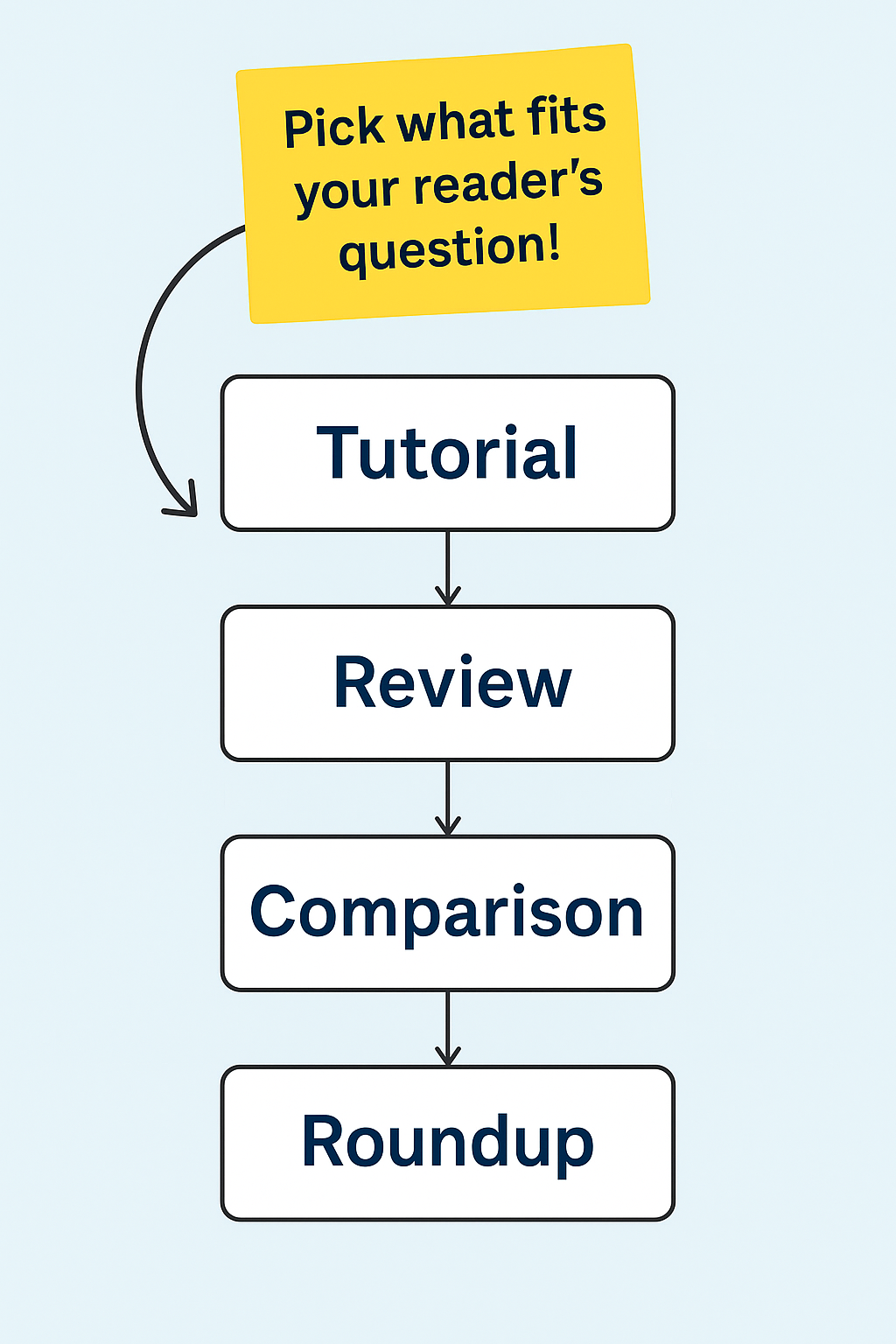
Think about it like you’re answering a friend’s question.
If they asked how to use something, you’d show them step by step.
That is a tutorial post.
If they said, “Is this worth my money?” you’d tell them what you love and what drives you nuts.
That is a review post.
If they were stuck between two options, you’d help them figure out which one fits best.
That is a comparison post.
And if they asked, “What should I even get for this problem?” you’d give them your short list of what actually works.
That is a roundup.
Pick the format that makes it easy for your reader to decide.
I find it works best to write a few different post formats for the same affiliate so you can reach all kinds of buyers.
For example, I have a Link Whisper review, 2 tutorials (one on how to use it generally, and one on how to use it for affiliate income), and I include it in my roundup of best plugins for bloggers.
I could do a comparison, too, but honestly, I don’t like anything about the competitors enough to bother writing it. A comparison needs to have some positives for the other options, and if I don’t find any, I’d rather skip it.
5. Get Clear And Outline What Your Reader Actually Wants
Outlining isn’t some boring academic chore. It’s you getting your shit together so you don’t ramble like a loon.
Start with the problem your reader actually has.
What’s bugging them so much they’re up Googling it at 2 a.m.? That’s your hook.
Put it right up front. Don’t make them scroll through to find it.
Next, write down every question they’d have before they throw money at the thing.
Will it even work?
Is it a pain in the ass to use?
What if it breaks or doesn’t fit?
Now, dump all your real, messy experience on those questions. Be honest! Did it annoy you? Did it surprise you? Got screenshots or proof? Show them!
Don’t hide the weird or annoying bits. If it makes noise or takes a lot of effort, say so. Then explain why it’s still worth it. Those negatives may not be a dealbreaker for some, but for other’s it might be. And you’ll piss those people off if you don’t pre-warn them.
Finally, make the next step stupidly obvious. Where do they click? No guessing. No “maybe if you want”.
For example, when I wrote about Theo’s dog crocs, I kicked off with the problem — paws get burnt on hot pavement. Then I covered every damn question — how to get them on without a fight, do they stay on swimming, and why I still buy them two summers later.
That is how you write a post that feels like a friend giving real advice.
6. Write Like You’re Talking To Your Best Friend
Now that you’ve got your outline — the real questions and honest answers — it’s time to write.
This is about being yourself. Your reader wants your voice, your stories, your real talk. Don’t overthink it.
Keep your paragraphs short so your post doesn’t look like a wall of text. Use bullet points or numbered lists to make it easy to skim.
Drop in real examples and mini stories. Tell them why this tool or product makes your life easier, or what annoyed you about it. Be honest — no sugarcoating.
If you’re ever stuck, ask yourself: “If my friend had X problem, how would I tell them about this thing as a solution?”
7. Add Your Affiliate Links Where They Can’t Be Missed

If your readers can’t find your affiliate links, you don’t make money.
So slap those links everywhere that makes sense — the headline, images, right after you explain why this product actually matters, and in your final call to action.
People aren’t gonna hunt for your links, especially on phones. Make sure there’s a link every 1 to 2 page scrolls so they can tap it whenever the hell they want.
And please don’t just say “Buy now” or “Click here.” That’s lazy and boring.
Write your CTAs to match what your reader needs right now:
- If your reader just wants to get it done, say something like: “Book the hotel with the best robe I have ever worn today”
- If your reader wants to know they are making a good choice, say: “See why so many pet owners choose these crocs”
- If your reader buys based on stories and feelings, say: “Check out these crocs that saved countless dog paws this summer”
- If your reader needs all the facts before they buy, say: “Check out why these crocs are perfect for summer walks”
Drop your CTAs right after you solve a problem or answer a question. That’s when your reader is most ready to buy.
And don’t forget to make your affiliate links visible!
Use text boxes with a different background colour to make your CTAs pop without feeling pushy. Make sure the links themselves are a different colour from the text so they stand out as clickable.
No one can click a link if they thinks it’s just normal text.
8. Link Internally to Get Your Affiliate Posts Seen (& Clicked)
Now that you have written an affiliate post with helpful content and visible links, you need to get eyes on it.
That is where internal linking does the heavy lifting.
Google usually doesn’t want to rank affiliate posts because they’re often thin or just pitchy junk. When you follow everything above — writing something genuinely helpful, packed with real experience — you already stand out from the junk. But you still need to prove it fits your site.
That is what internal linking does. It shows Google your affiliate post belongs in your silo, adds to your topical authority, and is not just a one-off money grab.
And even if Google still doesn’t want to rank it, your internal links make sure your readers can actually find it while they’re loving your other content.
Link to your affiliate post from 10+ other related posts that naturally connect.
If you have a post about summer dog care, link to your dog croc post right where it you talk about hot pavement. Use anchor text that makes sense — “How to protect your dog’s paws this summer” is a lot more helpful than “click here.”
And link back out from your affiliate posts, too. Keep people moving around your site, building more trust with every click!
Internal linking is the underrated backbone of getting your helpful affiliate posts seen, clicked, and making money — even when Google plays hard to get.
9. Publish It and Keep Tweaking Until It Converts
You wrote it, linked it, and hit publish. Amazing!
But you’re not done.
Affiliate posts aren’t guaranteed to convert the first time you write them. That’s where the marketing comes in.
After the post’s been live for 3 to 6 months, check your clicks and conversions. Are people actually clicking your links? Are they buying? Or are they dropping off halfway through?
If you see tumbleweeds, don’t freak out!
Most of the time, it just needs a small fix.
Maybe your links are buried too far down. Maybe your CTAs don’t match how your reader wants to buy. Maybe you missed a question they still need answered.
Make some tweaks to see if you can improve it.
Move your links higher. Add stronger CTAs. Drop in a new section that answers an obvious “but what if” your reader’s still Googling after reading your post.
A good affiliate post isn’t something you write once and forget about. It’s a living piece of content that gets better every time you check what’s working and fix what’s not.
In the my Profitable Part-Time Blogger program, I show you exactly how I audit my affiliate posts to double my income with 0 extra pageviews. Plus, you’ll get my affiliate blog post framework and my tracker spreadsheets to make auditing your posts so much easier!
Stop guessing, hoping, or waiting for magic clicks!
Get objective and analyze your post so you can actually spot (and fix) what’s blocking those sales.
Examples of Well Written Affiliate Posts
Still not sure what this looks like in real life? Here are a few ways I (and my PPTB students) have used these exact steps to write affiliate posts that actually make money without feeling gross:
- Keysearch Review from an Expert SEO
- How to Use Link Whisper for Automatic Internal Linking
- 5 Best Ghost Tour Destinations In The US
- Special Tours Whale Watching Reykjavik: Responsible Tour Review
- PredictWind Review: Pros, Cons & Real Use at Sea
- Walt Disney World Swan Hotel With Kids (2025): My Honest Review as a Solo Parent
- Airalo Review: Why This eSIM Has Become a Travel Essential
- Best Credit Cards and Fintech Banks for Digital Nomads
- Keio Plaza Hotel Tokyo Review: Ideal Spot for First-Timers
- $200K+ Passive Income Etsy Shop: My Go-To Tools
- Fly Drive Tasmania Solo: A Wilderness & Wildlife Adventure
- aloSIM Review: No More Airport eSIM Nightmares (+ 10% Off)
- Is This the Ultimate E-Reader? 2024 Kindle Paperwhite Review
- 13 Travel Essentials with Toddlers: What We Use on Every Trip
- Lingopie Review: My Honest Take on Learning Italian From TV
- An Unforgettable Athens Acropolis Tour: Everything You Need to Know Before You Go
- The Ultimate Guide to Entertaining your Kids on Travel Days
- York Ghost Walks: The Best Spooky Tours to Take in the City of 1,000 Ghosts
- Is the Priority Wine Pass Worth it For First Time Visitors
- The Union Club Hotel: The Best Hotel Near Purdue University
- 7 Best Flightseeing Tours in Alaska
- The Best Hand Mixer for Casual Bakers: Cuisinart HM-50
- Renting a car at Lisbon Airport + best deals
- Why Paris Vacation Rental Apartments Beat Hotel Stays
- Doubtful Sound Day Cruise Review: Everything You Need To Know
- Best Shoes for Olympic National Park Trails, Towns & Beaches
- Chiang Mai White Water Rafting Trip: Family-Friendly Review
- Mexico City by Hot Air Balloon: Volare Tour Review
- Is Interrail Worth it for Outdoor Family Travel?
- My Worldpackers Review After One Year of Volunteering
- The Best Street Food Tour in Cartagena with 9 Tasty Stops
- The Best Personal Item Backpack for Budget Airline Travelers
- Best Walking Shoes for Rainy Weather Travel [for Women]
- Must-Have Travel Photography Gear For Your Next Adventure
- Why The Encyclopedia of Country Living Belongs on Your Bookshelf
- 10 Healthy Airplane Snacks to Avoid Bloat and Fatigue
Profitable Part-Time Blogger
Ready to grow a blogging business that fits your life?
The Profitable Part-Time Blogger Program helps you attract your ideal audience, master SEO, and make $5K/month—all in just 20 hours a week.
Whether it’s a side hustle or your dream job, it’s time to work smarter, not harder. Let’s make your blog work for you!
Ready to Write Affiliate Posts That Actually Pay You?
Churning out dozens of half-baked posts that sound like a ChatGPT used car salesman won’t make you money
You need posts that actually fit your niche, help your reader make a decision they already want to make, and keep working long after you hit publish.
That doesn’t happen by luck. It happens when you have a real strategy and know how to fix what’s not working instead of guessing and hoping for clicks.
That’s exactly what you’ll learn inside the Affiliate Module in the Profitable Part-Time Blogger. I’ll show you how to pick the right products, write posts that feel human (not pushy), and run my exact audit process so you know what’s working and what to fix.
You’ll get my proven affiliate framework that scaled me to $30k months in less than 6 months, my tracker spreadsheets, and real examples that make it easy to follow.
If you’re tired of feeling like affiliate income is just for other people, come see how I do it step-by-step.
Read More About Monetizing Your Blog
- 60 Best Travel Affiliate Programs for Bloggers
- How to Make Money as a Travel Blogger: 15 Ways I Made $30k
- Ezoic Review: Will it Increase Your Blog Revenue?
- Mediavine Requirements (And How to Reach Them)
- Travelpayouts Review: 6 Figure Travel Blogger Weighs In
- How I Made $26.5k on Black Friday by Blogging & What I Learned Along the Way
- Blog Business Planning Workshop: Setting Profitable and Achievable Goals
- How I Made $110k in a Month in June 2023 👀
- 19 Best Ad Networks for Bloggers to Make 6 Figures
- How to Make $6k on a Digital Product Flash Sale
- I Sold a Starter Site For $2k. Here’s Exactly What I Did!
- How to Use Link Whisper to Increase Affiliate Conversions
- Selling Digital Products with Email Marketing for Beginners ft. Kate Doster
- Growing a Niche Site to $50k Series
- How to Make Your First $10 From Affiliate Sales in 7 Steps
- Are ConvertKit Email Ads Worth It? 6 Week Case Study Review
